
How Many Types of Barcode Scanners Are There? A Complete Guide
Posted on
There are several types of barcode scanners, and it’s important to choose the one that best fits your needs. Whether in retail, warehouse environments, hospitals, or hotels, there’s a barcode scanner designed for your application. Below, we’ll discuss the different types of barcode scanners and their features to help you find the best match for your needs.
1D versus 2D Barcode Scanners
The two main classes of barcode scanners are one-dimensional (1D) and two-dimensional (2D). One-dimensional barcode scanners are designed to reflect light off a barcode and then decode the information that bounces back. 1D barcodes can only hold up to 25 characters, so 1D scanners are slightly more limited in their features. Because of this simplicity, 1D scanners are typically more cost-effective.
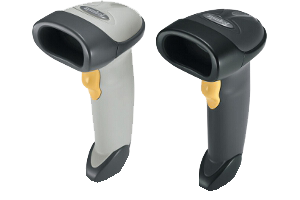
In comparison, two-dimensional barcode scanners function by taking a picture of the barcode. The image is optimized for contrast and then decoded to read the information. 2D barcodes can read both horizontally and vertically, allowing them to hold up to 2,000 characters. This class of scanner can read both 2D and 1D barcodes.
Types of Barcode Scanners
There are three basic varieties of barcode scanners: laser scanners, CCD or linear imager scanners, and area imagers.
Laser Barcode Scanners
Laser barcode scanners read one-dimensional barcodes, capturing data by reflecting light on the barcode and decoding the reflected information. They are limited to a 2–24” scanning range and typically struggle to read damaged barcodes. Laser scanners used to be considered the fastest option; however, many CCD or linear imager scanners now have equivalent or even faster scanning speeds. The simplicity of these barcode scanners makes them among the most affordable.
CCD & Linear Imager Barcode Scanners
CCD (charge-coupled device) or linear imagers use technology like that of a digital camera. Hundreds of light sensors capture and convert barcode images into readable data. CCD and linear imagers can read poor or damaged barcodes at distances of two feet or more.
Area Imagers
Area imagers, also known as array imagers, have wider reading capabilities than laser and linear imager scanners. These scanners use 2D technology to capture a detailed image and decode the data. Area imagers can read any type of barcode, including 1D, stacked, 2D, and QR codes. They are also capable of scanning from any orientation at distances of more than 3 feet. This flexibility reduces scanning labor. One downside of area imagers, however, is that they are typically slower than 1D imagers due to their complexity.
How to Choose the Right Barcode Scanner
Choosing the right barcode scanner comes down to understanding your specific needs and the environment in which it will be used. Consider the following factors to ensure you select the best scanner for your application:
- Type of barcode: Determine whether your business primarily uses 1D, 2D, or QR codes.
Scanning environment: Consider lighting conditions, printing resolution, distance, and potential obstacles. - Durability and reliability: Assess whether the scanner will be used in indoor or outdoor environments, rugged or high-traffic areas, or harsh temperatures. Dusty, damp, or humid conditions can also impact your scanner selection.
- Speed and efficiency: Evaluate how quickly the scanner needs to read barcodes and how many items will typically be processed.
- Budget: Balance the cost of your barcode scanners with features and your performance requirements.
- Orientation flexibility: Decide if you need a scanner that can read barcodes from multiple angles.
By weighing these factors, you can choose a barcode scanner that meets your operational needs while improving efficiency and accuracy. Learn more about our selection of barcode scanners to find the perfect fit for your business.